Sukuk is one of the most vital instruments in the modern Islamic finance landscape. Often described as “Islamic bonds,” this is a helpful starting point, but it’s technically an oversimplification.
In this article, you’ll understand why, how these instruments are structured, and why they play such a critical role in global capital markets.
What Exactly Is a Sukuk?
The word “Sukuk“ is the plural of the Arabic word “Sakk,” which essentially means a certificate or a deed. In modern finance, the Islamic Financial Services Board (IFSB) defines it as certificates of equal value that represent undivided ownership in tangible assets, usufructs (the right to use an asset), services, or the ownership of an asset or a particular project.
Why Aren’t Sukuk Just “Bonds”?
To answer this, we first need to understand what a bond actually is.
A conventional bond is a debt obligation — a loan from an investor to an issuer, where the issuer promises to repay the principal plus interest. In Islam, the charging and paying of interest (riba) is strictly prohibited. Sukuk also cannot be traded at par value, since doing so would violate a core Shariah ruling against the sale of debt to a third party, known in Arabic as bay’ al-dayn min ghayri man ‘alayhi al-dayn (بیع الدین من غیر من علیہ الدین).
This points to the fundamental difference: a bond represents debt, and the return on it amounts to riba. A Sukuk, on the other hand, cannot be a debt instrument. It is an asset-based or asset-backed investment that represents a tangible asset, a usufruct, or a service. In other words, when you buy a Sukuk, you are not lending money. You are participating in the ownership of an income-generating asset.
Sukuk vs. Conventional Bonds at a Glance
| Feature | Conventional Bond | Sukuk |
| Nature of Contract | Debt (Loan) | Ownership (Certificate) |
| Relationship | Creditor and Debtor | Partner/Owner and User |
| Underlying Asset | Not required (can be pure debt) | Required (must be tangible) |
| Return | Interest (Riba) | Profit share / Rent / Fee |
| Risk Exposure | Issuer’s creditworthiness | Performance of the underlying asset |
| Use of Proceeds | Flexible (any legal purpose) | Restricted (must be Shariah-compliant) |
The Core Principles That Govern Every Sukuk
To understand how we move from debt to genuine investment, it helps to look at the foundational principles behind every Sukuk structure:
- Asset-Linked — There must be an underlying asset. This ties the financial activity to the real economy rather than pure speculation.
- Profit and Loss Sharing — Returns must come from the performance of the underlying asset (rent from a building, profits from a venture), not from a fixed, predetermined interest rate.
- Shariah Compliance — The underlying assets must be halal. It cannot be backed by prohibited industries such as gambling, alcohol, or conventional interest-based banking.
- Prohibition of Gharar — The structure must avoid excessive uncertainty. Investor rights and obligations must be clearly defined.
- Structural Integrity — Each Sukuk must follow the Shariah rules of the specific contract it’s built on. You cannot, for example, issue this on an Ijarah (lease) basis while applying the rules of partnership or sale.
The Anatomy of a Sukuk Issuance
How does a company or government actually issue it? Typically, through a Special Purpose Vehicle (SPV).
- The Originator — the company or entity that needs funds.
- The SPV—an independent legal entity created specifically to hold the assets and issue the certificates.
The process usually looks like this:
- The originator transfers assets (a building, a fleet of planes, etc.) to the SPV.
- The SPV issues certificates to investors — the Sukuk holders.
- Investors pay the SPV for these certificates.
- The SPV passes that money on to the originator.
- The underlying assets generate cash flow, which flows back to investors as their return.
The Five Major Types
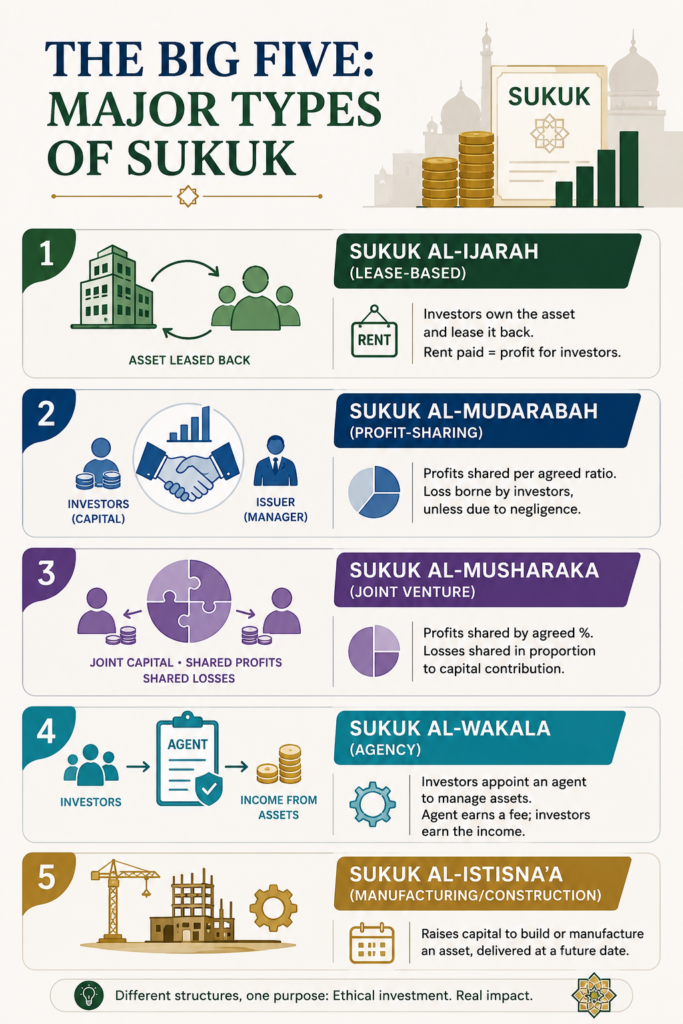
AAOIFI has issued numerous standards covering various structures, but five types dominate the market:
1. Sukuk Al-Ijarah (Lease-Based)
The most popular structure. Think of it as a sale-and-leaseback arrangement: investors own the asset and lease it back to the issuer. The rent paid by the issuer becomes the profit for investors. In practice, the originator sells its asset through the SPV to subscribers (the Sukuk holders), who then lease that same asset back to the originator for rent.
2. Sukuk Al-Mudarabah (Profit-Sharing)
A partnership structure where the issuer acts as manager and investors provide the capital. Profits are split according to a pre-agreed ratio. If there’s a loss, investors bear it — unless the loss resulted from the manager’s negligence.
3. Sukuk Al-Musharaka (Joint Venture)
Both the issuer and investors contribute capital to a project. Profits are shared based on an agreed percentage, while losses are shared strictly in proportion to each party’s capital contribution.
4. Sukuk Al-Wakala (Agency)
Investors appoint an agent — the issuer — to manage a portfolio of assets. The agent earns a management fee, while investors receive the income generated from the underlying assets.
5. Sukuk Al-Istisna’a (Manufacturing/Construction)
Used to fund projects such as factories or infrastructure. The Sukuk raises capital to fund the creation of an asset that will be delivered at a future date.
Risks and the Road Ahead
No investment is without risk, and Sukuk are no exception. Risk in Sukuk is typically tied to the performance of the underlying asset and the creditworthiness of the obligor. There are also regulatory challenges to navigate, since different jurisdictions treat the “ownership” of assets differently under their legal frameworks.
Conclusion
Sukuk has evolved from a niche product into a mainstream global financial tool used by governments and corporations alike. They offer a unique way to bridge the gap between ethical, value-based investment and the need for liquid, tradable financial instruments. As the world increasingly turns toward Sustainable, Responsible, and Impact (SRI) investing, sukuk are naturally positioned to lead that charge.
Noor Shariah Solutions (part of AJMS Group) provides Sukuk management and Shariah advisory services to clients around the globe. For questions or to discuss how Sukuk structures could work for your organization, feel free to get in touch.