
In today’s digital economy, cashless payments have become an essential part of everyday life. From booking flights and paying bills to shopping online, credit and debit cards offer convenience and flexibility.
However, for Muslims who want to ensure their financial activities remain aligned with Shariah principles, conventional credit cards can raise important questions. Is using a conventional credit card permissible? What happens when Shariah-compliant alternatives are unavailable? And are there circumstances in which using a credit card may be tolerated?
Let’s explore the key Shariah principles, the concerns surrounding conventional credit cards, and some practical alternatives.
Why Are Conventional Credit Cards Generally Not Permissible?
The primary Shariah concern surrounding conventional credit cards is riba (interest).
A conventional credit card agreement typically includes a condition that interest will be charged if the outstanding balance is not paid within the specified period. From an Islamic perspective, entering into a contract that contains an interest-bearing condition is problematic, even if the cardholder intends to pay the full balance on time.
The Key Shariah Concern: Riba
Riba is strictly prohibited in Islam. Therefore, the concern is not limited to whether interest is actually paid. The underlying contractual arrangement itself may contain an interest-based condition.
For this reason, many contemporary Islamic scholars advise Muslims to avoid conventional credit cards where suitable alternatives are available.
In practical terms, this means Muslims should consider:
- Avoiding conventional credit card agreements that contain interest clauses.
- Not relying on credit facilities that can result in interest payments.
- Choosing Shariah-compliant payment alternatives whenever reasonably available.
- Reviewing the terms and conditions of any financial product before using it.
Debit Cards: A Practical Shariah-Compliant Alternative
For everyday transactions, debit cards are generally a preferable alternative to conventional credit cards.
A debit card normally allows you to spend money that is already available in your bank account. Instead of borrowing through a revolving credit facility, the transaction is deducted from your existing balance.
This eliminates the conventional interest-based borrowing mechanism associated with credit cards.
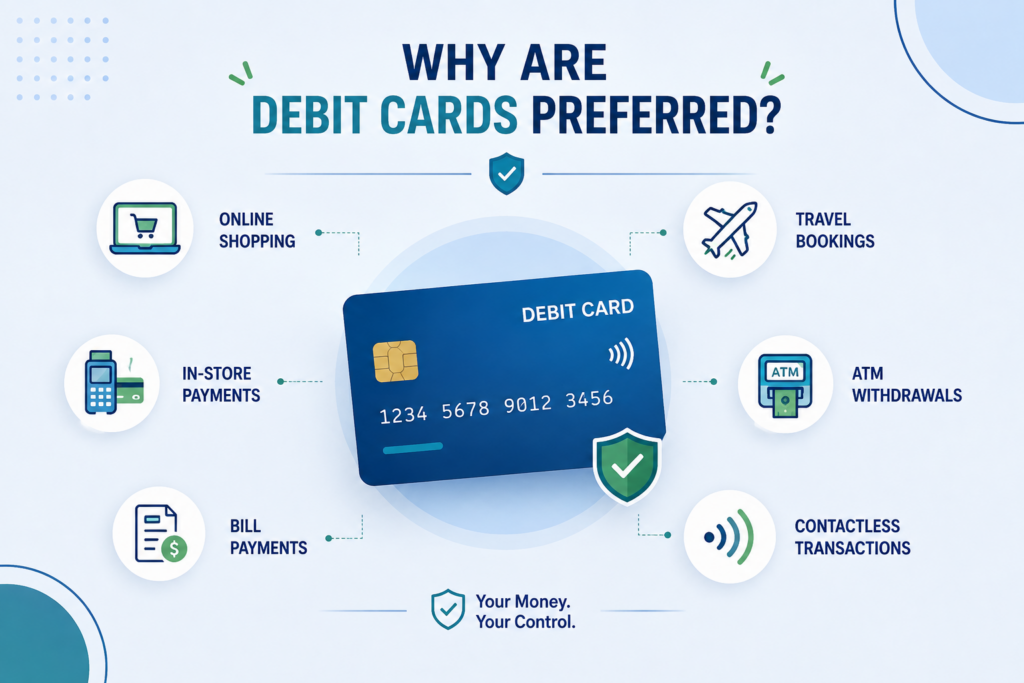
Why Are Debit Cards Preferred?
Debit cards can provide many of the same practical benefits as credit cards, including:
- Online shopping
- In-store payments
- Bill payments
- Travel bookings
- ATM withdrawals
- Contactless transactions
Where a suitable debit card is available and accepted, it can therefore be a straightforward way to manage everyday spending without entering into a conventional interest-based credit arrangement.
What If a Debit Card or Islamic Alternative Is Not Available?
The situation can become more complicated when a person does not have access to a suitable alternative.
For example, a particular country or payment system may have limited access to Islamic financial products. Certain merchants may accept only credit cards for specific transactions, or an individual may need a payment method for an essential service that cannot reasonably be accessed otherwise.
In Islamic jurisprudence, principles relating to Dharurah (necessity) and Hajah (genuine need or hardship) may provide limited flexibility in certain circumstances.
However, such flexibility should not be treated as a general permission to use conventional credit cards. It should be assessed carefully, based on the individual’s circumstances and the availability of reasonable alternatives.
Where a qualified scholar permits limited use because of genuine need, certain conditions may apply.
Conditions for Limited Use of a Conventional Credit Card
1. Avoid Paying Any Interest
The most important practical condition is to ensure that no interest is incurred or paid.
A cardholder should establish a reliable system for paying the entire outstanding balance before the payment deadline. Automatic payments or other safeguards may help reduce the risk of accidentally missing a payment.
The objective is to ensure that the card does not result in an actual Riba payment.
However, it is important to understand that avoiding interest payments does not necessarily remove the Shariah concern surrounding an agreement that itself contains an interest-based condition.
2. Use the Card Only for Permissible Transactions
The card should not be used for purchases or services that are themselves prohibited under Shariah.
This means avoiding transactions involving impermissible activities or goods, such as:
- Alcohol
- Gambling
- Interest-based financial transactions
- Other products or services prohibited under Islamic principles
The nature of the underlying transaction remains important regardless of the payment method.
3. Genuine Need and Lack of Reasonable Alternatives
Any concession based on Hajah or Dharurah should be limited to the actual circumstances that create the need.
Before relying on such an exception, a person should consider whether other reasonable options are available, such as:
- A debit card
- A prepaid card
- A Shariah-compliant card
- Bank transfer
- Cash payment
- Another permissible payment method
The principle of necessity should not become a reason for choosing a conventional credit card simply because it offers greater convenience or rewards.
4. Seek Guidance and Exercise Taqwa
Questions involving necessity and financial contracts can be highly dependent on individual circumstances and the exact terms of the card agreement.
Therefore, where a person believes that they have a genuine need to use a conventional credit card, consulting a qualified Shariah scholar can help determine whether the specific situation falls within a recognized exception.
A Muslim should also maintain Taqwa (God-consciousness) and avoid questionable financial arrangements whenever a practical alternative exists.
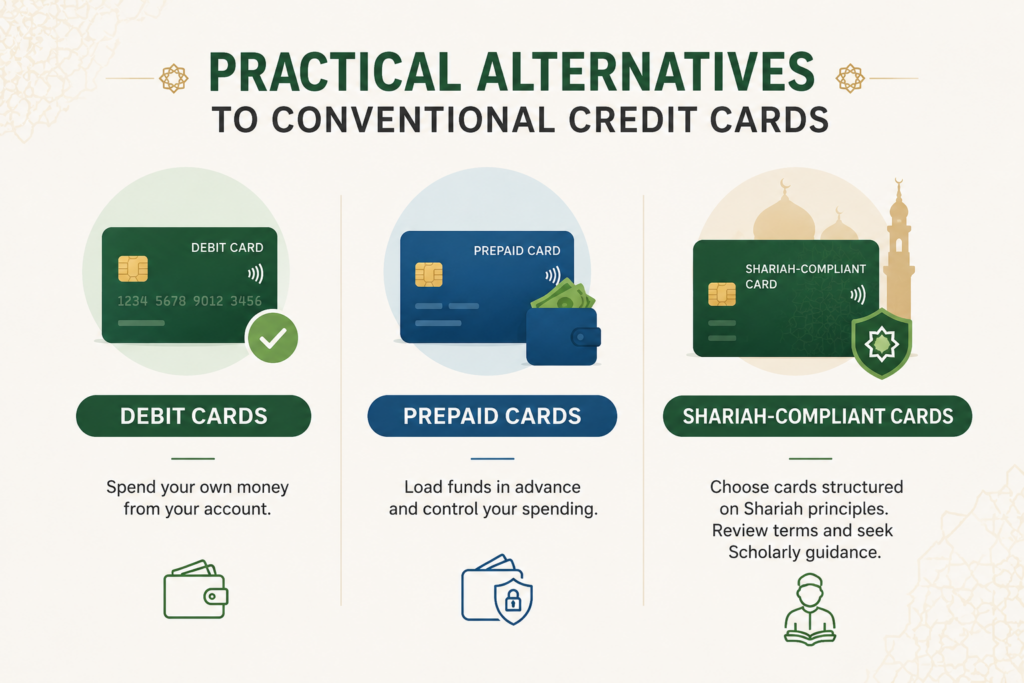
Practical Alternatives to Conventional Credit Cards
For Muslims seeking to avoid conventional credit card arrangements, several alternatives may be worth considering.
Debit Cards
Debit cards are often the simplest option for everyday purchases because they use funds already available in the customer’s account.
Prepaid Cards
Prepaid cards can provide additional control over spending by allowing users to load funds before making purchases, depending on the structure and terms of the product.
Shariah-Compliant Cards
Some Islamic financial institutions offer cards structured according to Shariah principles. However, the fact that a product is marketed as “Islamic” does not automatically mean every feature is compliant.
Users should consider the underlying contract, fees, penalties, and structure and, where necessary, seek guidance from a qualified Shariah advisor.
The Bottom Line
The central concern with conventional credit cards under Shariah is the presence of interest-based contractual conditions. As a general principle, Muslims should avoid such arrangements where reasonable alternatives are available.
Debit cards and appropriately structured Shariah-compliant payment products can offer practical alternatives for everyday transactions.
Where genuine hardship or necessity exists and no reasonable alternative is available, some contemporary scholars may allow limited use subject to specific conditions. Such circumstances should be treated as an exception rather than a general rule.
Ultimately, responsible Islamic finance is not only about avoiding interest. It also involves understanding contracts, assessing alternatives, and making financial decisions with Shariah compliance, transparency, and Taqwa in mind.